
A JOURNEY FULL OF EMOTIONS AND SPONTANEITY

The Estonian pianist and composer Kristjan Randalu has already received numerous international awards, including a Grammy nomination. He has been twice honored with the Estonian Music Award and was featured on the Best of 2020 list of The New York City Jazz Record. His recordings have been released by renowned jazz labels like ECM and Enja. His last album Dichterliebe was released on Berlin Classics, in which he dedicates himself purely to the piano, performing Robert Schumann’s Dichterliebe song cycle. For his current album Schubert Voyage, also released by Berlin Classics, the pianist has chosen another Romantic song cycle. This time, it is Franz Schubert’s Winterreise, Op. 89. Instead of working solo again, he has teamed up with the bassoonist Martin Kuuskmann, who has also been awarded the Estonian Music Award multiple times. For their joint Winterreise, they blend elements of classical music and jazz.

Franz Schubert’s Winterreise is based on 24 poems by Wilhelm Müller. The song cycle tells the story of a lonely wanderer who, after a failed love, walks through a wintry landscape. In the songs, he reflects on his sadness, despair, and inner conflict, while grappling with memories and longings. Essential themes that must have also occupied Franz Schubert. By the time he composed Winterreise, Schubert was already suffering from syphilis and did not live to see the work’s publication in 1828. His music conveys the emotional depth and melancholic mood of the texts. Kristjan Randalu and Martin Kuuskmann capture this melancholic atmosphere in their purely instrumental interpretations, shedding contemporary light on these romantic compositions.

For his album, Kristjan Randalu selected 14 songs from the Winterreise cycle for arrangement and supplemented them with four original compositions: “Schreck,” “Vorschau,” “Winterschlaf,” and “Nachtwind.” In his Winterreise, the bassoon essentially takes on the role of the singer. The keys remain the same as in Schubert’s version, while the time signatures and moods change. For example, in “Gute Nacht,” continuous triplets can be heard on the piano over Schubert’s original 2/4 time signature. This minimalist polymeter creates an unsettled pulse that enhances the dark mood of the piece. “Basically, everything is notated except for Kristjan’s improvisations on the piano. The audience won’t always be able to tell what’s written and what’s not. I have a few solo parts that go through the roof. These solo parts were actually composed and written out by Kristjan,” explains the Estonian-American bassoonist.
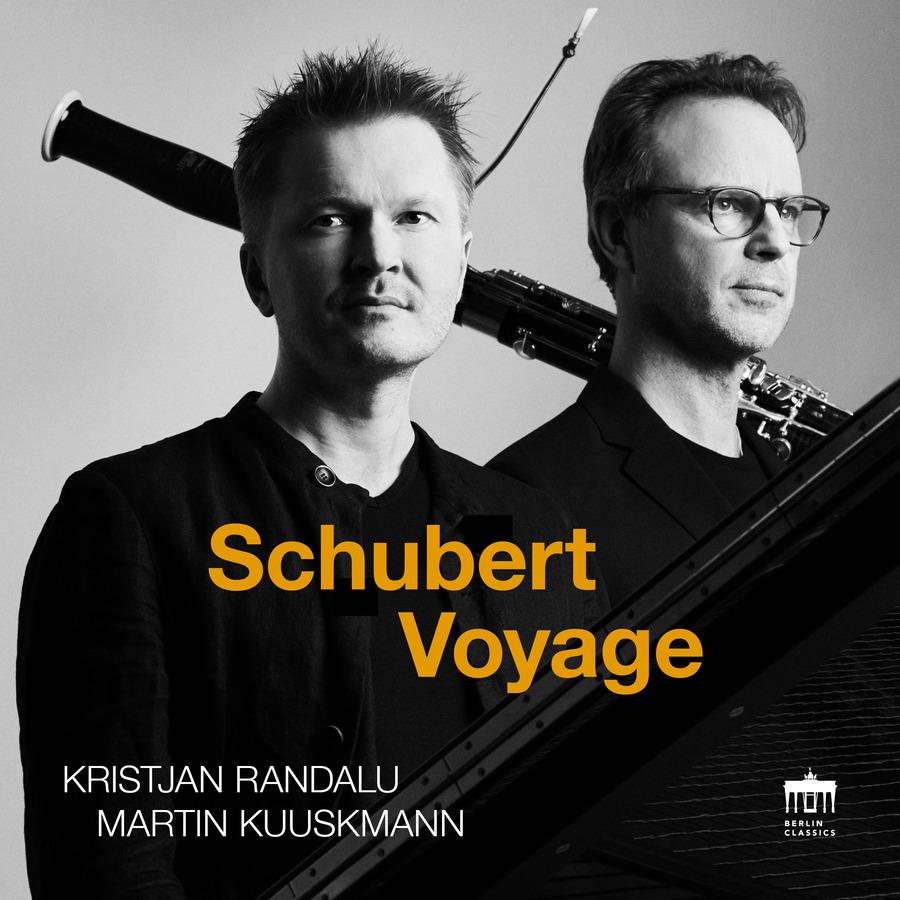
Schubert Voyage Kristjan Randalu & Martin Kuuskmann

Release-Cover „Schubert Voyage“ mit Pianist Kristjan Randalu und Fagottist Martin Kuuskmann. Schwarz-Weiß-Foto zweier Musiker mit sichtbarem Fagott und Flügel, überlagert von gelber Typografie; frontale Porträtkomposition mit klarer, moderner Wirkung.

Artist

Kristjan Randalu
Kristjan Randalu
Martin Kuuskmann
Martin Kuuskmann

Composer

Kristjan Randalu
Franz Schubert

Further information

Genre

Klassik
Jazz

Publication date

14.03.2025


A JOURNEY FULL OF EMOTIONS AND SPONTANEITY


The Estonian pianist and composer Kristjan Randalu has already received numerous international awards, including a Grammy nomination. He has been twice honored with the Estonian Music Award and was featured on the Best of 2020 list of The New York City Jazz Record. His recordings have been released by renowned jazz labels like ECM and Enja. His last album Dichterliebe was released on Berlin Classics, in which he dedicates himself purely to the piano, performing Robert Schumann’s Dichterliebe song cycle. For his current album Schubert Voyage, also released by Berlin Classics, the pianist has chosen another Romantic song cycle. This time, it is Franz Schubert’s Winterreise, Op. 89. Instead of working solo again, he has teamed up with the bassoonist Martin Kuuskmann, who has also been awarded the Estonian Music Award multiple times. For their joint Winterreise, they blend elements of classical music and jazz.


Franz Schubert’s Winterreise is based on 24 poems by Wilhelm Müller. The song cycle tells the story of a lonely wanderer who, after a failed love, walks through a wintry landscape. In the songs, he reflects on his sadness, despair, and inner conflict, while grappling with memories and longings. Essential themes that must have also occupied Franz Schubert. By the time he composed Winterreise, Schubert was already suffering from syphilis and did not live to see the work’s publication in 1828. His music conveys the emotional depth and melancholic mood of the texts. Kristjan Randalu and Martin Kuuskmann capture this melancholic atmosphere in their purely instrumental interpretations, shedding contemporary light on these romantic compositions.


For his album, Kristjan Randalu selected 14 songs from the Winterreise cycle for arrangement and supplemented them with four original compositions: “Schreck,” “Vorschau,” “Winterschlaf,” and “Nachtwind.” In his Winterreise, the bassoon essentially takes on the role of the singer. The keys remain the same as in Schubert's version, while the time signatures and moods change. For example, in “Gute Nacht,” continuous triplets can be heard on the piano over Schubert’s original 2/4 time signature. This minimalist polymeter creates an unsettled pulse that enhances the dark mood of the piece. “Basically, everything is notated except for Kristjan’s improvisations on the piano. The audience won’t always be able to tell what’s written and what’s not. I have a few solo parts that go through the roof. These solo parts were actually composed and written out by Kristjan,” explains the Estonian-American bassoonist.

Tracklist - These are the tracks you will hear on the album

Schubert Voyage
Kristjan Randalu & Martin Kuuskmann
1
Gute Nacht
2
Gefrorene Tränen
3
Schreck
4
Erstarrung
5
Der Lindenbaum
6
Wasserflut
7
Auf dem Flusse
8
Vorschau
9
Rückblick
10
Rast
11
Winterschlaf / Frühlingstraum
12
Einsamkeit
13
Die Krähe
14
Im Dorfe
15
Nachtwind / Der stürmische Morgen
16
Der Wegweiser

More videos from Kristjan Randalu & Martin Kuuskmann

previous
next

Other publications by Kristjan Randalu & Martin Kuuskmann

{"email":"Email address invalid","url":"Website address invalid","required":"Required field missing"}